Consulting field – Digital growth and innovation
Global digital marketing strategy
The challenge
Our client, an international industrial company with a large number of business units, was confronted with the increasing complexity of digital marketing. In recent years, the portfolio of digital measures had grown significantly, driven by different market requirements, new technological possibilities and rising customer expectations. Nevertheless, there was a lack of a uniform strategic direction, clear priorities and coordinated implementation across the various business units.
Previous marketing activities were largely decentralised: each unit developed its own digital initiatives, selected channels, messages and content independently and worked according to individual priorities. This led to a heterogeneous customer experience, inefficient use of resources and a lack of comparability of results. In global communication and digital lead generation in particular, it became apparent that synergies were not being utilised sufficiently. At the same time, there was growing pressure to utilise marketing budgets in a more targeted manner and to make the impact of all measures transparent.
Our client's initial question was therefore: How can we strategically align our digital marketing activities, prioritise the relevant initiatives and ensure consistent customer centricity at the same time? Which fields of action and customer journeys are crucial for our future growth? And how do we create a joint roadmap that enables short-term success and provides long-term orientation?
Procedure
Together with the client's marketing and digital team, we developed a comprehensive strategic framework for digital marketing in a multi-stage, collaborative process. To begin with, we conducted an audit of the existing digital activities. This involved analysing and evaluating all relevant measures along the customer journey and reflecting on their contribution to the company's goals. At the same time, we conducted interviews with managers from the business units and central functions to understand pain points, best practices and expectations of digital marketing.
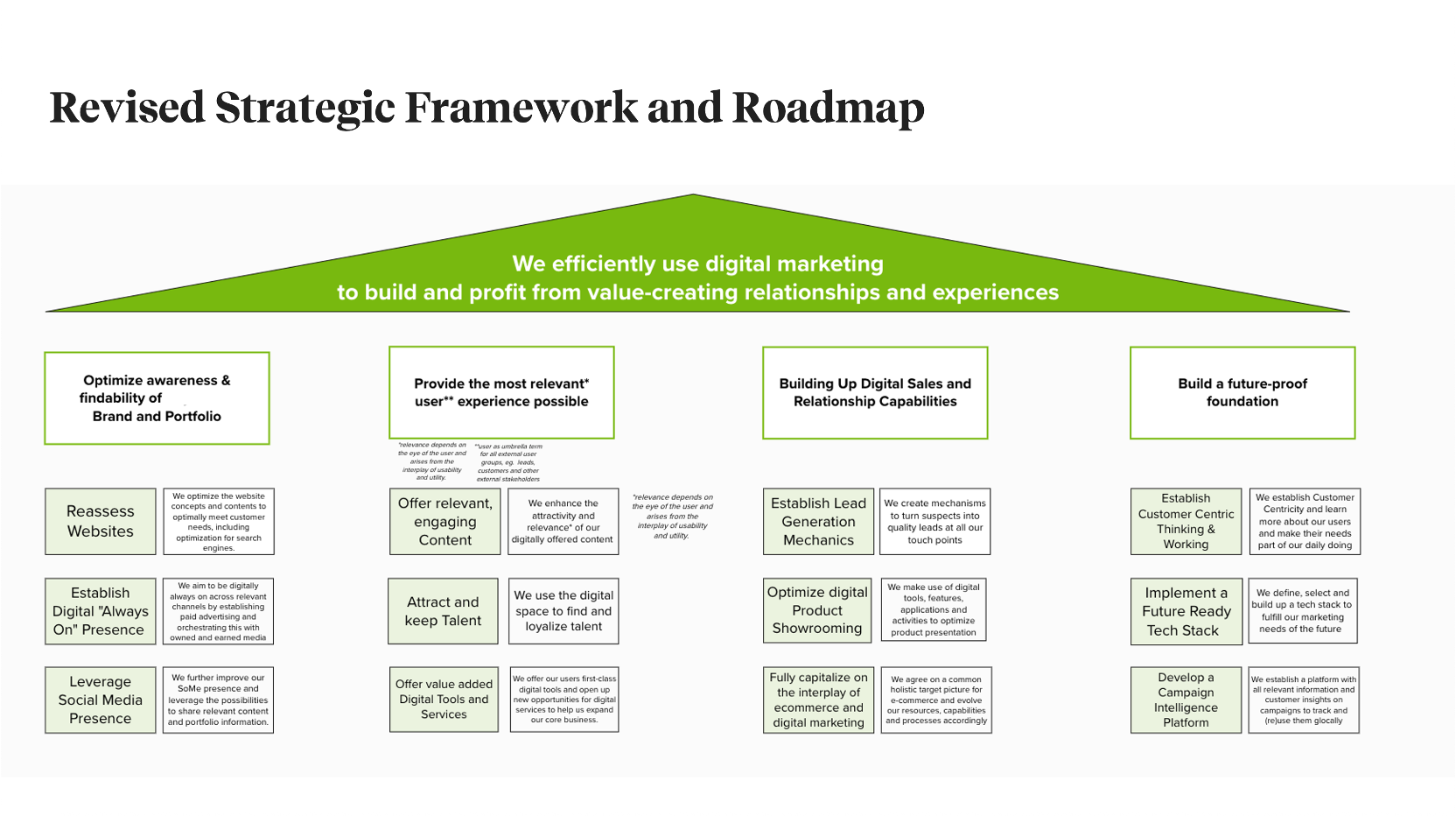
Building on this, we organised several workshops with international business units. The aim was to develop a shared vision for digital marketing and involve all relevant stakeholders in the development of the strategy. Step by step, a target vision for 2026 was formulated, strategic priorities derived and specific areas of action identified. The discussion centred on the most important customer journeys: Which digital touchpoints and experiences are particularly crucial for our customers? Which topics and content create measurable added value along the journey?
After consolidating the content, we developed a prioritised roadmap. It translates the strategic fields of action into specific work packages, assigns responsibilities and creates transparency regarding quick wins and long-term initiatives. A particular focus was on dovetailing the activities between central marketing and business units to ensure both efficiency and local relevance.
The approach was deliberately iterative: After each round of workshops, the results were consolidated, transferred into a strategic framework and honed in the next iteration with the stakeholders. This not only resulted in a consistent strategy, but also broad acceptance within the company.
Results and benefits
On completion of the project, the client had an integrated, strategic digital marketing framework for the first time. This defines clear objectives, priorities and fields of action and serves as a binding guide for everyone involved. The jointly developed roadmap enables efficient management of resources and creates transparency regarding the implementation steps – from short-term quick wins to long-term initiatives.
The defined customer journeys act as a common thread for all digital measures and strengthen customer centricity. Marketing activities can now be planned and optimised specifically along the decisive relationship moments. At the same time, the business units benefit from greater coordination, clear processes and a standardised target orientation.
Overall, the project led to a measurable improvement in marketing efficiency, greater internal transparency and a significant increase in customer experience. The organisation is now able to prioritise digital marketing activities based on data, react more quickly to market changes and actively exploit synergies between the units. This has created the basis for sustainable, growth-orientated digital marketing that supports the corporate strategy in the long term.