Online training: Brand management with clarity and structure
In this one-day, practical online training course, participants learn to understand and contextualise brand management in terms of its logic and impact. The course provides a clear understanding of what matters in brand management and how brand decisions can be made in a consistent, transparent and effective manner.
Brand management describes the strategic process of systematically building a brand’s value contribution over the long term. It involves consciously steering what a brand stands for, how it is perceived, and the role it plays for customers, employees and the company as a whole.
The aim of effective brand management is to systematically develop and position the brand, and to ensure that this is consistently reflected in its brand identity. By fostering a relevant, trusting and loyal relationship with customers over time, brand strength grows and the brand makes a measurable contribution to the company’s long-term success.
Brand management is therefore not a one-off project, but an ongoing management task.
Brand management is more demanding today than ever before: markets are changing rapidly, channels and formats are diversifying, and new technologies – such as AI – are changing the rules of the game in brand management and raising the bar.
Typical challenges in brand management: In practice, brand management often fails to realise its full potential for business success – not due to a lack of will, but because of structural patterns that recur in many organisations.
- Lack of brand definition: Many B2B companies lack a clear and actionable brand definition. As a result, there are no binding guidelines for brand decisions and no shared understanding of what the brand is intended to achieve and is capable of.
- Excessive complexity: Vision, purpose, core, values, personality, principles, benefits, reasons to believe, brand story, claim… Often, a multitude of models and terms coexist within companies, which tend to confuse rather than provide guidance.
- Lack of clear governance: In many B2B organisations, brand management is not carried out systematically. Time and resources are limited, brand management often takes place ‘on the side’, furthermore, responsibilities are unclear and decisions cannot be enforced.
Well-managed brands . . .
- have a clear core around which decisions are made
- reduce complexity rather than adding to it
- keep people and their needs firmly in mind
- remain consistent without becoming rigid
- use measurement for guidance, not for over-management
- think long-term, rather than constantly launching new initiatives
This is exactly where the training comes in.
Who is this training course for?
The training is aimed at brand managers who are involved in the day-to-day management or development of a brand (or are about to take on this role) and want to bring a pragmatic structure to their brand work. Brand management often takes place as a one-person show or within a small team, without a dedicated brand department or lead external agency.
Typical participants include
- Brand, marketing and communications managers in small and medium-sized enterprises and start-ups (both B2B and B2C, across all sectors)
- Managing directors/founders who help steer the brand
- Practitioners who handle brand-related tasks “on the side”
How does the training work?
The training takes the form of a full-day interactive online session. It combines theoretical concepts with concrete examples and targeted, practical exercises that can be applied to your own brand.
Training content
- Check-in:
Getting to know each other, setting objectives, aligning expectations, working methods - Orientation & Introduction:
Categorising typical challenges in brand management
Reflecting on the current state of your own brand using key questions
Identifying strengths and areas of uncertainty - Key Fundamentals & Models
Introduction to brand management, brand governance and brand experience
Distinguishing between brand identity and corporate identity
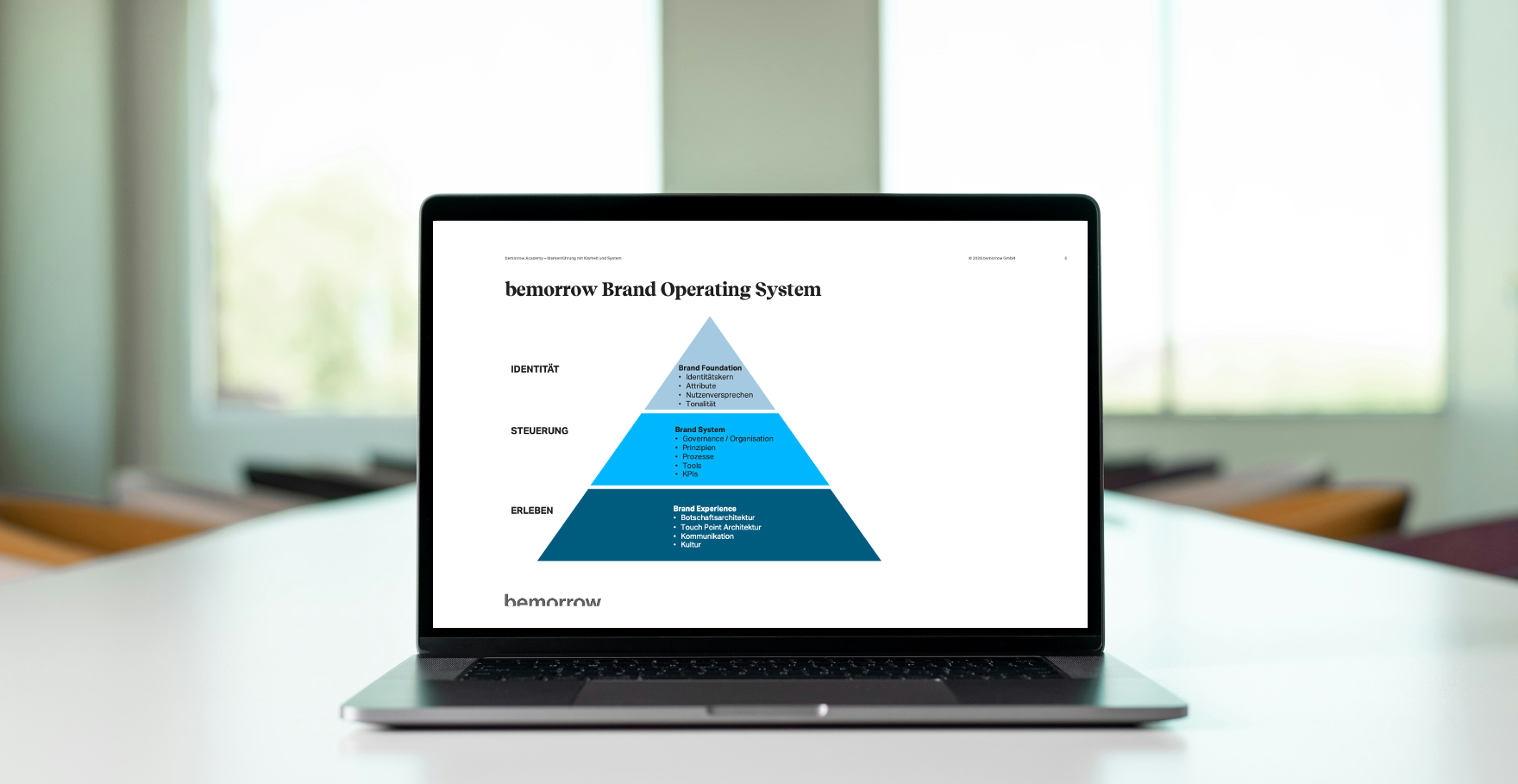
The bemorrow Brand Operating System as a framework for organisation and decision-making - Practical Exercises & Reflection
Selected exercises for application to one’s own brand and company
Classifying typical inconsistencies and potential for differentiation - Brand Management & Governance
How brand decisions are meaningfully prepared and made
Roles, responsibilities and decision-making principles in brand management
Brand metrics as a guide for decision-making - Transfer & Outlook
Deriving key insights for your own brand work
Conclusion, reflection and group discussion
Outcome of the training
By the end of the day, you will have a clear understanding of how brand management works systematically and how this knowledge can be applied to your own brand. This includes:
- the bemorrow Brand Operating System as a clear model and framework for effective brand management
- a sharper understanding of typical weaknesses in brand work
- concise documents and cheat sheets for practical application
- clarity on where your own brand stands today and where the issues lie
- concrete ideas for your own brand management
Optional components
Follow-ups
Following the training, several follow-up sessions can be arranged. These are designed to reflect on specific issues arising from brand practice, clarify any outstanding questions, and provide support in applying the Brand Operating System to your own brand. The aim is to build confidence in its application and effectively embed brand management into day-to-day operations.
Theory meets practice: additional module
On request, we combine the training content with the practical application of structured brand management within your own organisation and corporate structure. Together, we organise existing brand content, develop it further in a targeted manner, and support the integration of brand management into decision-making processes, collaboration and communication. The aim is not only to understand brand management, but to put it into practice effectively.
How much does the training cost?
€1,499 plus VAT per person for a full-day online training course with a minimum of 3 and a maximum of 6 participants.
Follow-ups and ‘Theory Meets Practice’ add-on module → Price on request
Cancellation is free of charge up to two weeks before the training begins. Invoicing takes place two weeks before the booked date, and the full price for the training and any optional components becomes due. All prices are exclusive of VAT.
Confidentiality & exchange during the training
The training thrives on openness and exchange among participants. Confidentiality is a key prerequisite for this. All participants undertake in writing to treat the content and insights gained from the training as confidential.
We ensure that no companies with a similar market focus participate in the same group. The groups are deliberately composed of participants from different sectors to facilitate open exchange and mutual learning.
Peer feedback is an optional feature. Each participant decides for themselves how much insight they wish to share regarding their own brand work. Openness is welcome, but not mandatory.
Your advantages with bemorrow
We know what we’re talking about. We are experienced brand strategy and brand management experts, and we bring our practical experience directly into our training sessions. This makes the theory clear, tangible and easily applicable to your day-to-day work.
Practical training materials that are fun to use. We are convinced that it is not particularly easy to learn from a PDF with dozens of pages of continuous text. Instead, we work on the content collaboratively on a digital workboard and provide digital templates and frameworks for immediate use.
Digital for complete location flexibility. All sessions take place as online training, allowing you to participate from anywhere.
Relaxed processing. Fair cancellation policies and invoicing that isn't months in advance ensure that you can concentrate fully on the training.
The experts


Julia Daubertshäuser is a brand strategist and facilitator with over 15 years’ experience in agencies and strategy consultancies. She has built, refined and managed brands across a range of contexts – from positioning and brand identity through to experience and communication, and right through to governance and decision-making structures. As a strategy and organisational consultant, she combines in-depth brand expertise with methodological clarity and a systemic perspective. Her focus is on reducing complexity and making brand management practical and actionable.
Klaus Schwab is the founder and managing partner of bemorrow and has many years of experience in holistic brand, marketing and customer experience consultancy. He supports companies in developing and implementing brand and growth strategies, as well as in designing digital services and business models. His focus lies on combining strategic clarity, entrepreneurial thinking and effective implementation.
Any questions or requests? Please feel free to contact Julia directly.
We look forward to hearing from you.